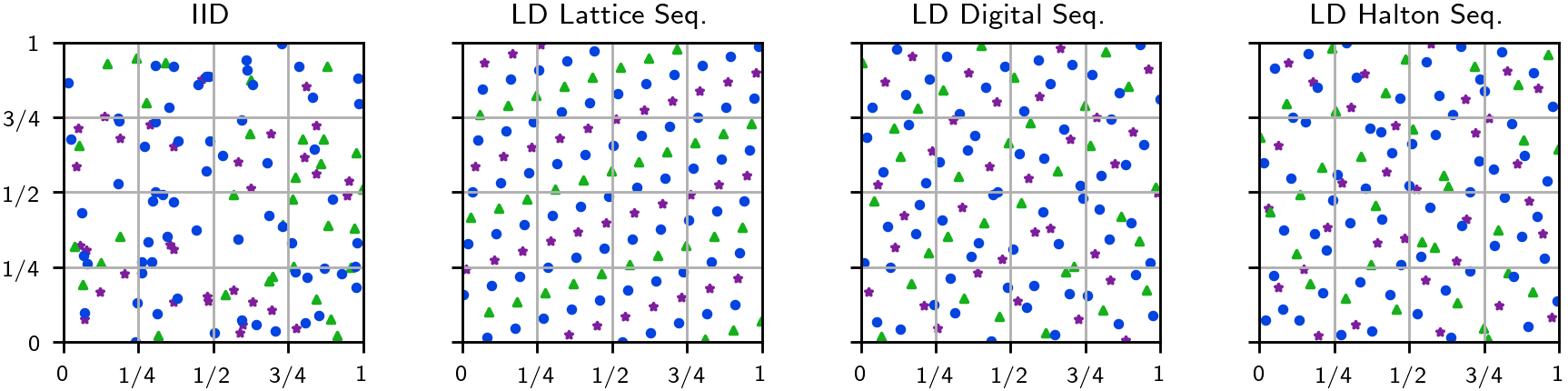
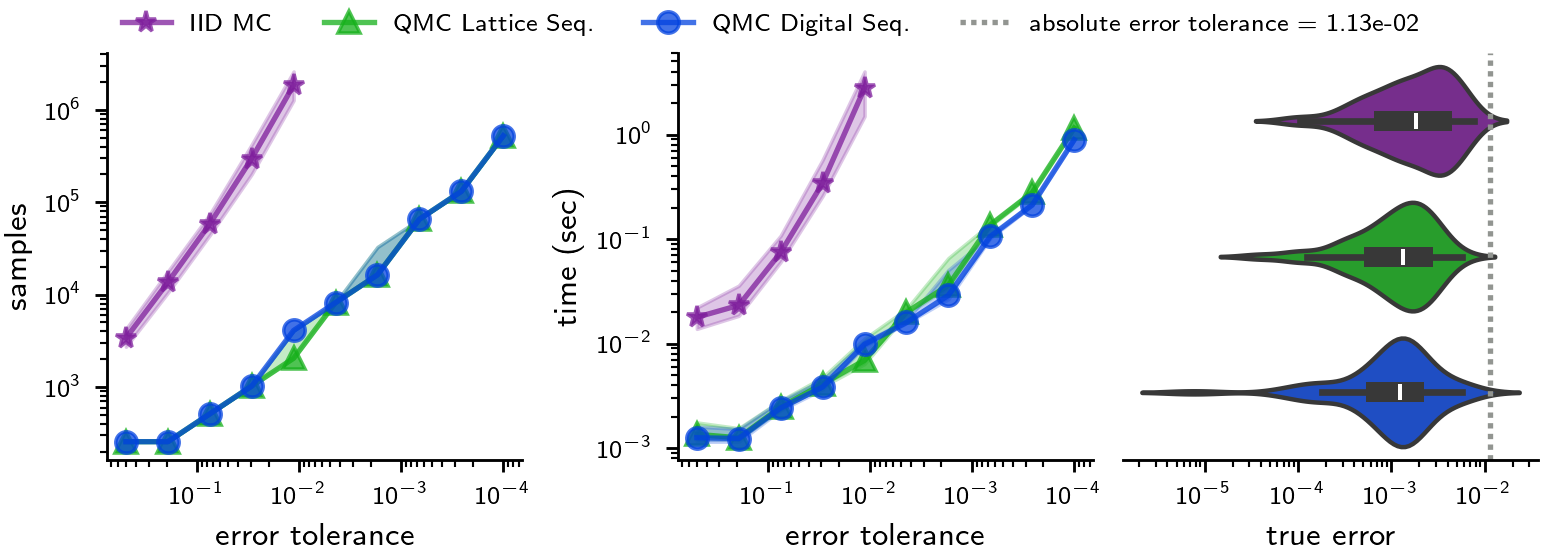
Monte Carlo (MC) methods estimate high-dimensional integrals by
computing sample averages at independent and identically distributed
(IID) random points. Quasi-Monte Carlo (QMC) methods replace IID samples
with low-discrepancy (LD) sequences which more uniformly cover the
integration domain, leading to faster convergence and reduced
computational requirements. The figure below visualizes IID and LD
sequences.
The authors acknowledge support from the U.S. National Science
Foundation grant DMS-2316011 and the Department of Energy Office of
Science Graduate Student Research Program. We thank the international
(Q)MC research community as well as JOSS reviewers and editors for
invaluable and timely feedback and support.
This article has been co-authored by employees of National Technology
and Engineering Solutions of Sandia, LLC under Contract No. DE-NA0003525
with the U.S. Department of Energy (DOE). The employees co-own right,
title and interest in and to the article and are responsible for its
contents. The United States Government retains and the publisher, by
accepting the article for publication, acknowledges that the United
States Government retains a non-exclusive, paid-up, irrevocable,
world-wide license to publish or reproduce the published form of this
article or allow others to do so, for United States Government purposes.
The DOE will provide public access to these results of federally
sponsored research in accordance with the DOE Public Access Plan (https://www.energy.gov/downloads/doe-public-access-plan).
AS is partially supported by DARPA The Right Space
HR0011-25-9-0031.
Albert, R., and A.-L. Barabási. 2002.
“Statistical Mechanics of
Complex Networks.” Reviews of Modern Physics 74 (1):
47–97.
https://doi.org/10.1103/RevModPhys.74.47.
Bernhard, Jonah E, Peter W Marcy, Christopher E Coleman-Smith, Snehalata
Huzurbazar, Robert L Wolpert, and Steffen A Bass. 2015.
“Quantifying Properties of Hot and Dense QCD Matter
Through Systematic Model-to-Data Comparison.” Physical Review
C 91 (5): 054910.
https://doi.org/10.1103/physrevc.91.054910.
Chen, Wilson Ye, Lester Mackey, Jackson Gorham, Francois-Xavier Briol,
and Chris Oates. 2018.
“Stein Points.” In
Proceedings
of the 35th International Conference on
Machine Learning, edited by Jennifer Dy
and Andreas Krause, 80:844–53. Proceedings of Machine Learning Research.
PMLR.
https://proceedings.mlr.press/v80/chen18f.html.
Choi, S.-C. T. 2014.
“MINRES-QLP Pack and Reliable
Reproducible Research via Staunch Scientific Software.”
Journal of Open Research Software 2 (1): 1–7.
https://doi.org/10.5334/jors.bb.
Choi, S.-C. T., Yuhan Ding, Fred J. Hickernell, Lan Jiang, Ll. A.
Jiménez Rugama, D. Li, Jagadeeswaran Rathinavel, et al. 2021.
“GAIL: Guaranteed Automatic
Integration Library (Versions
1.0–2.3.2).” https://doi.org/10.5281/zenodo.4018189.
Choi, S.-C. T., Yuhan Ding, Fred J. Hickernell, Jagadeeswaran
Rathinavel, and Aleksei G. Sorokin. 2024.
“Challenges in
Developing Great Quasi-Monte Carlo
Software.” In
Monte Carlo and
Quasi-Monte Carlo
Methods: MCQMC, Linz,
Austria, July 2022, 209–22. Springer.
https://doi.org/10.1007/978-3-031-59762-6_9.
Choi, S.-C. T., F. J. Hickernell, J. Rathinavel, M. J. McCourt, and A.
G. Sorokin. 2022.
“Quasi-Monte Carlo
Software.” In
Monte Carlo and
Quasi-Monte Carlo
Methods: MCQMC, Oxford,
England, August 2020, edited by A.
Keller, 23–50. Springer Proceedings in Mathematics and Statistics.
Springer, Cham.
https://doi.org/10.1007/978-3-030-98319-2_2.
Choi, S.-C. T., Fred J. Hickernell, Jagadeeswaran Rathinavel, Michael
McCourt, and Aleksei G. Sorokin. 2026.
“QMCPy: A
Quasi-Monte Carlo Python
Library.” Python Software, Zenodo.
https://doi.org/10.5281/zenodo.3964489.
Cools, Ronald, Frances Y Kuo, and Dirk Nuyens. 2006.
“Constructing
Embedded Lattice Rules for Multivariate Integration.” SIAM
Journal on Scientific Computing 28 (6): 2162–88.
https://doi.org/10.1137/06065074x.
Coveyou, RR, and Robert D MacPherson. 1967.
“Fourier Analysis of
Uniform Random Number Generators.” Journal of the ACM
(JACM) 14 (1): 100–119.
https://doi.org/10.1145/321371.321379.
Cranley, R., and T. N. L. Patterson. 1976.
“Randomization of
Number Theoretic Methods for Multiple Integration.” SIAM
Journal on Numerical Analysis 13: 904–14.
https://doi.org/10.1137/0713071.
Dick, J. 2011.
“Higher order scrambled
digital nets achieve the optimal rate of the root mean square error for
smooth integrands.” The Annals of Statistics 39
(3): 1372–98.
https://doi.org/10.1214/11-AOS880.
Dick, J., and M. Feischl. 2021.
“A Quasi-Monte
Carlo Data Compression Algorithm for Machine
Learning.” Journal of Complexity 67: 101587.
https://doi.org/10.1016/j.jco.2021.101587.
Dick, J., Frances Y Kuo, and Ian H Sloan. 2013.
“High-Dimensional
Integration: The Quasi-Monte Carlo
Way.” Acta Numerica 22: 133–288.
https://doi.org/10.1017/s0962492913000044.
Dick, J., and F. Pillichshammer. 2010.
Digital Nets and Sequences:
Discrepancy Theory and Quasi-Monte Carlo
Integration. Cambridge: Cambridge University Press.
https://doi.org/10.1017/CBO9780511761188.
Dick, J., and Friedrich Pillichshammer. 2005.
“Multivariate
Integration in Weighted Hilbert Spaces Based on
Walsh Functions and Weighted Sobolev
Spaces.” Journal of Complexity 21 (2): 149–95.
https://doi.org/10.1016/j.jco.2004.07.003.
Ding, Y., F. J. Hickernell, and Ll. A. Jiménez Rugama. 2020.
“An
Adaptive Algorithm Employing Continuous Linear Functionals.” In
Monte Carlo and
Quasi-Monte Carlo
Methods: MCQMC, Rennes,
France, July 2018, edited by P. L’Ecuyer
and B. Tuffin, 324:161–81. Springer Proceedings in Mathematics and
Statistics. Springer, Cham.
https://doi.org/10.1007/978-3-030-43465-6_8.
Giles, Michael B, and Benjamin J Waterhouse. 2009.
“Multilevel
Quasi-Monte Carlo Path Simulation.”
Advanced Financial Modelling, Radon Series on Computational and
Applied Mathematics 8: 165–81.
https://doi.org/10.1515/9783110213140.165.
Halton, J. H. 1960.
“On the Efficiency of Certain Quasi-Random
Sequences of Points in Evaluating Multi-Dimensional Integrals.”
Numerische Mathematik 2: 84–90.
https://doi.org/10.1007/bf01386213.
Harris, Charles R., K. Jarrod Millman, Stéfan J. van der Walt, Ralf
Gommers, Pauli Virtanen, David Cournapeau, Eric Wieser, et al. 2020.
“Array Programming with NumPy.”
Nature 585 (7825): 357–62.
https://doi.org/10.1038/s41586-020-2649-2.
Hickernell, F. J., S.-C. T. Choi, L. Jiang, and Ll. A. Jiménez Rugama.
2018.
“Monte Carlo Simulation, Automatic
Stopping Criteria For.” In
Wiley
StatsRef-Statistics
Reference Online, edited by M. Davidian,
B. Everitt, R. S. Kenett, G. Molenberghs, W. Piegorsch, and F. Ruggeri.
John Wiley & Sons Ltd.
https://doi.org/10.1002/9781118445112.stat08035.
Hickernell, F. J., L. Jiang, Y. Liu, and A. B. Owen. 2013.
“Guaranteed Conservative Fixed Width Confidence Intervals via
Monte Carlo Sampling.” In
Monte Carlo and Quasi-Monte
Carlo Methods 2012, edited by J. Dick, F. Y. Kuo, G.
W. Peters, and I. H. Sloan, 65:105–28. Springer Proceedings in
Mathematics and Statistics. Springer-Verlag, Berlin.
https://doi.org/10.1007/978-3-642-41095-6_5.
Hickernell, F. J., and Ll. A. Jiménez Rugama. 2016.
“Reliable
Adaptive Cubature Using Digital Sequences.” In
Monte Carlo and Quasi-Monte
Carlo Methods: MCQMC, Leuven,
Belgium, April 2014, edited by R. Cools
and D. Nuyens, 163:367–83. Springer Proceedings in Mathematics and
Statistics. Springer-Verlag, Berlin.
https://doi.org/10.1007/978-3-319-33507-0_18.
Hickernell, F. J., Ll. A. Jiménez Rugama, and D. Li. 2018.
“Adaptive Quasi-Monte Carlo Methods for
Cubature.” In
Contemporary Computational
Mathematics — a Celebration of the 80th Birthday of
Ian Sloan, edited by J. Dick, F. Y. Kuo,
and H. Woźniakowski, 597–619. Springer-Verlag.
https://doi.org/10.1007/978-3-319-72456-0_27.
Hickernell, F. J., N. Kirk, and A. G. Sorokin. 2026.
“Quasi-Monte Carlo Methods: What, Why,
and How?” In
Monte Carlo and
Quasi-Monte Carlo
Methods: MCQMC, Waterloo,
Canada, August 2024, edited by C. Lemieux
and B. Feng. Accepted for publication; Springer, Cham.
https://doi.org/10.48550/arXiv.2502.03644.
Hickernell, F. J., C. Lemieux, and A. B. Owen. 2005.
“Control
Variates for Quasi-Monte Carlo.”
Statistical Science 20: 1–31.
https://doi.org/10.1214/088342304000000468.
Hickernell, F. J., and X. Wang. 2002.
“The Error Bounds and
Tractability of Quasi-Monte Carlo Algorithms
in Infinite Dimension.” Mathematics of Computation 71:
1641–61.
https://doi.org/10.1090/S0025-5718-01-01377-1.
Jiménez Rugama, Ll. A., and F. J. Hickernell. 2016.
“Adaptive
Multidimensional Integration Based on Rank-1 Lattices.” In
Monte Carlo and Quasi-Monte
Carlo Methods: MCQMC, Leuven,
Belgium, April 2014, edited by R. Cools
and D. Nuyens, 163:407–22. Springer Proceedings in Mathematics and
Statistics. Springer-Verlag, Berlin.
https://doi.org/10.1007/978-3-319-33507-0_20.
Joe, S., and F. Y. Kuo. 2003.
“Remark on Algorithm 659:
Implementing Sobol’s Quasirandom Sequence
Generator.” ACM Transactions on Mathematical Software
29: 49–57.
https://doi.org/10.1145/641876.641879.
Joe, S., and Frances Y. Kuo. 2008.
“Constructing
Sobol Sequences with Better Two-Dimensional
Projections.” SIAM Journal on Scientific Computing 30
(5): 2635–54.
https://doi.org/10.1137/070709359.
Kaarnioja, V., Y. Kazashi, F. Y. Kuo, F. Nobile, and Ian H. Sloan. 2021.
“Fast Approximation by Periodic Kernel-Based Lattice-Point
Interpolation with Application in Uncertainty Quantification.”
Numerische Mathematik 150: 33–77.
https://doi.org/10.1007/s00211-021-01242-3.
Kuo, F. Y. 2007.
“Lattice Rule Generating Vectors.” https://web.maths.unsw.edu.au/~fkuo/lattice/.
Kuo, F. Y., and D. Nuyens. 2016.
“Application of
Quasi-Monte Carlo Methods to Elliptic
PDEs with Random Diffusion Coefficients – a Survey of
Analysis and Implementation.” Foundations of Computational
Mathematics 16: 1631–96.
https://doi.org/10.1007/s10208-016-9329-5.
L’Ecuyer, Pierre, Pierre Marion, Maxime Godin, and Florian Puchhammer.
2022.
“A Tool for Custom Construction of QMC and
RQMC Point Sets.” In
Monte
Carlo and Quasi-Monte
Carlo Methods: MCQMC,
Oxford, England, August
2020, edited by A. Keller, 51–70. Springer Proceedings in
Mathematics and Statistics. Springer, Cham.
https://doi.org/10.1007/978-3-030-98319-2_3.
L’Ecuyer, Pierre, Marvin K Nakayama, A. B. Owen, and Bruno Tuffin. 2023.
“Confidence Intervals for Randomized Quasi-Monte
Carlo Estimators.” In
2023 Winter
Simulation Conference (WSC),
445–56. IEEE.
https://doi.org/10.1109/wsc60868.2023.10408613.
Landau, David P, and Kurt Binder. 2014.
A Guide to Monte
Carlo Simulations in Statistical Physics. Cambridge
University Press.
https://doi.org/10.1017/9781108780346.
Lemieux, C. 2004.
“Randomized Quasi-Monte
Carlo: A Tool for Improving the Efficiency of Simulations
in Finance.” In
Proceedings 2004 Winter
Simulation Conference, edited by R. G.
Ingalls, M. D. Rossetti, J. S. Smith, and B. A. Peters, 1565–73. IEEE
Press.
https://doi.org/10.1109/wsc.2004.1371499.
Marzouk, Youssef, Tarek Moselhy, Matthew Parno, and Alessio Spantini.
2016.
“Sampling via Measure Transport: An Introduction.” In
Handbook of Uncertainty
Quantification, edited by Roger Ghanem, David Higdon,
and Houman Owhadi, 1–41. Cham: Springer International Publishing.
https://doi.org/10.1007/978-3-319-11259-6_23-1.
Matoušek, J. 1998.
“On the
-Discrepancy
for Anchored Boxes.” Journal of Complexity 14: 527–56.
https://doi.org/10.1006/jcom.1998.0489.
Morokoff, W. J., and R. E. Caflisch. 1994.
“Quasi-Random Sequences
and Their Discrepancies.” SIAM Journal on Scientific
Computing 15: 1251–79.
https://doi.org/10.1137/0915077.
Niederreiter, H. 1978.
“Quasi-Monte
Carlo Methods and Pseudo-Random Numbers.” Bull.
Amer. Math. Soc. 84: 957–1041.
https://doi.org/10.1090/s0002-9904-1978-14532-7.
———. 1987.
“Point Sets and Sequences with Small
Discrepancy.” Monatshefte Für Mathematik 104: 273–337.
https://doi.org/10.1007/bf01294651.
———. 1992. Random Number Generation and Quasi-Monte
Carlo Methods. CBMS-NSF Regional Conference Series in
Applied Mathematics. Philadelphia: SIAM.
Nuyens, Dirk, and Ronald Cools. 2006.
“Fast Algorithms for
Component-by-Component Construction of Rank-1 Lattice Rules in
Shift-Invariant Reproducing Kernel Hilbert Spaces.”
Mathematics of Computation 75 (254): 903–20.
https://doi.org/10.1090/s0025-5718-06-01785-6.
Owen, A. B. 1995.
“Randomly Permuted
-Nets
and
-Sequences.”
In
Monte Carlo and
Quasi-Monte Carlo
Methods in Scientific
Computing, edited by H. Niederreiter and P. J.-S.
Shiue, 106:299–317. Lecture Notes in Statistics. Springer-Verlag, New
York.
https://doi.org/10.1007/978-1-4612-2552-2_19.
———. 2003.
“Variance with Alternative Scramblings of Digital
Nets.” ACM Transactions of Modeling and Computer
Simulation 13 (4).
https://doi.org/10.1145/945511.945518.
———. 2024.
“Error Estimation for Quasi-Monte
Carlo.” https://doi.org/10.48550/arXiv.2501.00150.
Owen, A. B., and Zexin Pan. 2024.
“Gain Coefficients for Scrambled
Halton Points.” SIAM Journal on Numerical
Analysis 62 (3): 1021–38.
https://doi.org/10.1137/23m1601882.
Parno, Matthew, Andrew Davis, and Linus Seelinger. 2021.
“MUQ: The MIT Uncertainty
Quantification Library.” Journal of Open Source
Software 6 (68): 3076.
https://doi.org/10.21105/joss.03076.
Parno, Matthew, Andrew Davis, Linus Seelinger, and Youssef Marzouk.
2014.
“MIT Uncertainty Quantification (MUQ)
Library.” https://mituq.bitbucket.io/source/_site/index.html.
Paszke, Adam, Sam Gross, Francisco Massa, Adam Lerer, James Bradbury,
Gregory Chanan, Trevor Killeen, et al. 2019.
“PyTorch: An
Imperative Style, High-Performance Deep Learning Library.” In
Advances in Neural Information
Processing Systems 32, 8024–35. Curran
Associates, Inc.
http://papers.neurips.cc/paper/9015-pytorch-an-imperative-style-high-performance-deep-learning-library.pdf.
Rathinavel, J. 2019.
“Fast Automatic Bayesian
Cubature Using Matching Kernels and Designs.” PhD thesis,
Illinois Institute of Technology.
http://hdl.handle.net/10560/islandora:1009768.
Rathinavel, J., and F. J. Hickernell. 2019.
“Fast Automatic
Bayesian Cubature Using Lattice Sampling.”
Statistics and Computing 29: 1215–29.
https://doi.org/10.1007/s11222-019-09895-9.
———. 2022.
“Fast Automatic Bayesian Cubature Using
Sobol’ Sampling.” In
Advances in
Modeling and Simulation:
Festschrift in Honour of Pierre
L’Ecuyer, edited by Z. Botev, A. Keller, C. Lemieux,
and B. Tuffin, 301–18. Springer, Cham.
https://doi.org/10.1007/978-3-031-10193-9_15.
Richtmyer, R. D. 1951.
“The Evaluation of Definite Integrals, and
a Quasi-Monte-Carlo Method Based
on the Properties of Algebraic Numbers.” LA-1342. Los Alamos
Scientific Laboratory.
https://doi.org/10.2172/4405295.
Robbe, Pieterjan. 2024.
“MultilevelEstimators.jl: A Julia
Package for Multilevel Monte Carlo.” https://github.com/PieterjanRobbe/MultilevelEstimators.jl.
Roy, Pamphile T., Art B. Owen, Maximilian Balandat, and Matt Haberland.
2023.
“Quasi-Monte Carlo Methods in
Python.” Journal of Open Source Software 8
(84): 5309.
https://doi.org/10.21105/joss.05309.
Seelinger, Linus, Vivian Cheng-Seelinger, Andrew Davis, Matthew Parno,
and Anne Reinarz. 2023.
“UM-Bridge:
Uncertainty Quantification and Modeling Bridge.”
Journal of Open Source Software 8 (83): 4748.
https://doi.org/10.21105/joss.04748.
Sobol’, I. M. 1967.
“The Distribution of Points in a Cube and the
Approximate Evaluation of Integrals.” U.S.S.R. Comput. Math.
And Math. Phys. 7: 86–112.
https://doi.org/10.1016/0041-5553(67)90144-9.
Sorokin, Aleksei G. 2025.
“QMCPy: A
Python Software for Randomized Low-Discrepancy Sequences,
Quasi-Monte Carlo, and Fast Kernel
Methods.” https://doi.org/10.48550/arXiv.2502.14256.
Sorokin, Aleksei G., Fred J. Hickernell, and Pierre L’Ecuyer. 2025.
“LDData: Low Discrepancy Generating Vectors and
Matrices.” https://github.com/QMCSoftware/LDData.
Sorokin, Aleksei G., and Jagadeeswaran Rathinavel. 2022.
“On
Bounding and Approximating Functions of Multiple Expectations Using
Quasi-Monte Carlo.” In
International Conference on Monte
Carlo and Quasi-Monte
Carlo Methods in Scientific
Computing, 583–99. Springer.
https://doi.org/10.1007/978-3-031-59762-6_29.
Tong, X., S.-C. T. Choi, Y. Ding, F. J. Hickernell, L. Jiang, Ll. A.
Jiménez Rugama, J. Rathinavel, K. Zhang, Y. Zhang, and X. Zhou. 2022.
“Guaranteed Automatic Integration Library (GAIL): An
Open-Source MATLAB Library for Function Approximation,
Minimization, and Integration.” Journal of Open Research
Software 10: 7.
https://doi.org/10.5334/jors.381.
Virtanen, Pauli, Ralf Gommers, Travis E. Oliphant, Matt Haberland, Tyler
Reddy, David Cournapeau, Evgeni Burovski, et al. 2020.
“SciPy 1.0: Fundamental Algorithms for
Scientific Computing in Python.” Nature Methods
17: 261–72.
https://doi.org/10.1038/s41592-019-0686-2.
Wang, X. 2003.
“Strong Tractability of Multivariate Integration
Using Quasi-Monte Carlo
Algorithms.” Mathematics of Computation 72: 823–38.
https://doi.org/10.1090/s0025-5718-02-01440-0.
Wang, X., and F. J. Hickernell. 2000.
“Randomized
Halton Sequences.” Mathematical and Computer
Modelling 32: 887–99.
https://doi.org/10.1016/s0895-7177(00)00178-3.
Wang, X., and Ian H. Sloan. 2005.
“Why Are High-Dimensional
Finance Problems Often of Low Effective Dimension?” SIAM J.
Sci. Comput. 27 (1): 159–83.
https://doi.org/10.1137/s1064827503429429.
Wang, Y., and F. J. Hickernell. 2002.
“An Historical Overview of
Lattice Point Sets.” In
Monte Carlo
and Quasi-Monte Carlo Methods 2000,
edited by K. T. Fang, F. J. Hickernell, and H. Niederreiter, 158–67.
Springer-Verlag, Berlin.
https://doi.org/10.1007/978-3-642-56046-0_10.
Zhang, Yiwei, Jinyang Li, Haoran Wang, and S.-C. T. Choi. 2021.
“Sentiment-Guided Adversarial Learning for Stock Price
Prediction.” Frontiers in Applied Mathematics and
Statistics 7: 8.
https://doi.org/10.3389/fams.2021.601105.